Thursday, April 14, 2011

Ten Lies to Tell an Author

What do you think is the most important thing for an author at a book signing? Apart from a pen that works. (Though I sat through one bookstore event where my pen was never needed, not once). But other than that? Chocolate? Bookmarks? Bottled water? All good things to have. But the best thing is a fun neighbor. Because for most of the two hours that these signings typically last, you will have nothing to do, so you might as well have an enjoyable conversation.

A good seat mate has the added benefit of helping one not to look too desperate as readers pass by one’s table, avoiding eye contact. If you aren’t in the big leagues the readers aren’t exactly lining up for your signature. I don’t even care (much) if no one buys a book, but it’s nice if people stop to chat.

Then I think of it from the point of view of the book buyer. You can’t buy everyone’s book. You don’t want to buy everyone’s book. And you don’t want to get guilt-tripped into spending more than you intended and ending up with an even more out-of-control TBR pile. You’re actually kind of interested in that particular book and you like the cover. If you were alone in a book store you’d pick it up, read the blurb and maybe read a page or two. But the author is sitting in front of you looking pathetic. If you look at the book isn’t it rude not to buy it?

No, it isn’t. As an author I’d rather you looked at my book and put it down again, than scurried by in case you hurt my feelings. Heck, I’d be perfectly happy if you’d stop and talk about the weather. So please, next time you are at a book signing as a buyer, either at a conference or in a bookstore, stop, look, and chat. You don’t need to buy a book. If you cannot bring yourself to leave without saying something, I recommend one of the following lies.

10 THINGS TO SAY TO AN AUTHOR
WHEN YOU DON’T BUY HER BOOK

(in descending order of author popularity)

1. I have all your books already and I loved every one of them.
2. I only read electronically. I’ll buy it on my Kindle when I get home
3. I’ve already bought too many books but I’ll get yours next time I’m in Barnes & Noble.
4. I always wait till the last book of the series comes out and then I buy them all.
5. Tell me about your next book. That sounds really interesting. I’ll wait for that.
6. It’s been nice meeting you. I shall follow your career with interest.
7. I’m taking a break from [name your genre] and only reading [name another genre]
8. I never read books with blond heroines.
9. My husband made me swear I wouldn’t bring home any more six-pack covers.
10. Where’s the bathroom?

If you live in the Boston area and wish to practice your lying, later this month I shall be the New England Romance Writers Conference at the Hawthorne Hotel in Salem, MA. A book fair, with over forty romance writers, will run from 4:00 pm to 5:30 pm on Saturday, April 30th. I’d love to have you stop by and tell me a lie. Failing that, tell me one in the comments section.

Saturday, March 26, 2011

A Mini Excerpt from The Amorous Education

Publication day of The Amorous Education of Celia Seaton is still four months away. I can't even reveal the cover yet, though it's coming soon. But just for fun I decided to post a mini-excerpt.

*****
The door to the humble structure was blocked by a body. The body of a man lying unconscious, wearing nothing but breeches and a pair of riding boots. It had been some years since Celia had seen the bare torso of a grown man, and never a white man. He was pale, as befit a man who was always dressed up to his neck, but the smattering of dark hair, covering the chest and descending in a vee over his flat stomach, didn’t disguise the fact that the skin covered well-formed muscles. This interesting masculine form distracted her only a few seconds from the astonishing fact that she knew him.

And although he was one of several men who had bedeviled her life, she did not actually wish him dead.

Kneeling on the ground she set her fingers to his temple and found a pulse. “Mr. Compton,” she said. “Mr. Compton, wake up. Are you well?”

Nothing. She rested her head on his chest. Judging by the strength of his heartbeat, Mr. Tarquin Compton would live to cause further distress to awkward arrivals on the London marriage mart. She supposed she’d better try to revive him. And much as she detested the creature, she was curious to discover why the ton’s most fashionable gentleman lay half-naked next to a deserted Yorkshire cottage.

Thursday, February 24, 2011

The King's Speech

Oscar night is coming up and I’m rooting for The King’s Speech. And not just because I’ve had a major crush on Colin Firth for years. What a terrific movie: great writing and great acting.

The story describes how the George VI overcame his stammer. It's also about the change to the monarchy brought about by modern communications, in this case radio. Suddenly it mattered how the king spoke. For a century or two the British royal family had basically been German and married members of German royal families. Even Edward VII is said to have spoken with a strong German accent. The family changed its name to Windsor from Saxe-Coburg-Gotha during World War I and from then on spoke like members of the British upper classes. But with radio bringing the king and his voice into millions of homes, sounding English wasn’t enough: he had to be articulate too.

Imagine having a disability and needing to overcome it for your job. And not a job you’ve chosen, but one that’s been thrust upon you by birth and circumstances. The hereditary ruling system, which almost everyone now agrees is absurd, could be tough for the rulers too. It didn’t matter what you wanted: if you were next in line you toed the line and did what had to be done. The hero of the book I’m writing now is the heir to a dukedom and has a secret disability that makes him unsuited to his eventual position. He starts out more like David, the elder brother in The King’s Speech who shirks his responsibilities and renounces the throne. But in the end he turns into more of a Bertie and does what has to be done, even though apparently deeply unsuited to the job. Luckily, like George VI whose relationship with his queen is so touchingly depicted, he has a heroine to help him.

Monday, November 29, 2010

Tarquin's Book has a Title

Tarquin Compton, the tall dark dandy with a taste for rare poetry and pornography, is the hero of my third Burgundy Club book. I can now reveal that the title of the book. THE AMOROUS EDUCATION OF CELIA SEATON will be published in August 2011. (Pre-order now from Amazon)

You may find the book listed around the web as How to Marry a Governess, but that was a placeholder while discussions went on with my publisher. I'm over the moon about The Amorous Education - it's really descriptive and not at all generic. By the way Celia is a governess so the placeholder wasn't inaccurate either. (I don't think it's a spoiler to let on that Tarquin and Celia get married in the end).

Settling on a title is quite a business, with all sorts of factors being considered, mostly relating to sales potential. My editor and I typically come up with dozens of ideas, most of them pretty terrible and many very silly. My all time favorite stupid title was a chick lit idea for NEVER RESIST TEMPTATION: Baking and Boinking - the sexy tale of a pastry chef and her bad boy British lord.

Hm. I kind of like it. Maybe we could do a reissue?

Saturday, October 9, 2010

What's Next?

Quite a few people have asked me what's coming after THE DANGEROUS VISCOUNT. While the information is buried somewhere on the website, I thought I'd better make it accessible.

My next book will feature Tarquin Compton, who is about to lose most of his clothes and be brought down a peg or several. I don't usually have anyone specific in mind when I create a hero, but Tarquin is very dark and I'm always happy to look at a picture of Richard Armitage (aren't you?) so here you are. The book is still untitled but it will be published in August 2011. I think the story is great fun and includes the reappearance of Sebastian, Diana, and Minerva from The DV.

I am working on a book about Minerva, Diana's little sister. I'm not saying anything more now except, in Minerva's case, "be careful what you wish for...." No release date for this one yet. Gotta finish it first.

Wednesday, September 29, 2010

Ladies Make Passes at Viscounts in Glasses

Sebastian Iverley, the hero of THE DANGEROUS VISCOUNT, is not your average romance hero.

1. He wears spectacles.
2. His clothing fits badly and it’s years out of fashion.
3. His hobby is rare book collecting.
4. His favorite means of communication is the grunt (which might be OK in a caveman romance but this is a Regency)
5. He despises women. That’s not so unusual but…
6. He has never had anything to do with women. Nothing. Nada. In fact he’s a [whisper] … virgin.

So what happens to this unpromising male specimen? He falls in love. He takes one look at Diana Fanshawe’s accidently exposed leg and he’s a goner. But sadly for Sebastian, Diana wants to be a duchess and she bets Sebastian’s detestable cousin Blake (a ducal heir) that she can get Sebastian to kiss her.

Poor Sebastian! When he finds out he’s devastated, he’s miserable, and hell hath no fury like a bookworm scorned. With the help of his buddies in the Burgundy Club he gets an extreme makeover and the fun begins.

Sebastian cleans up really well, and Diana can’t help noticing that he’s really quite the hunk. On the other hand she kind of misses the clever, inarticulate guy he used to be…

So romance readers. Are you ready for a nerd hero? Would you love him even if he didn’t get cleaned up?

[this blog has also been posted at avonromance.com]

Thursday, September 16, 2010

Getting ready for Tamara Lejeune Day

October 2010 is a big month in the world of historical romance. There are new books on the way from Liz Carlyle and Elizabeth Boyle, eagerly awaited debuts from Jenny Brown and Tiffany Clare, and not one but two books by Janet Mullany. There’s even a new book from yours truly. But all these events, thrilling as they may be, pale into insignificance beside the Really Big News. A new book by Tamara Lejeune. I for one will be beating on the doors of my local Borders, itching to get my hot little hands on CHRISTMAS WITH THE DUCHESS. And by God, Borders, you’d better have it in stock or There Will Be Trouble.


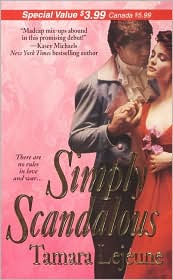
I discovered Ms. Lejeune by accident. SIMPLY SCANDALOUS is, I believe, the only book I’ve ever bought because Amazon told me I’d like it. Also, it was only $3.99 and I thought that was a special deal, just for me. (When I learned Zebra was selling books to every Thomasina, Richenda and Henrietta for $3.99 I stopped being excited about it.) Also, the color was such a repellent shade of pink I couldn’t resist. Best $3.99 (plus shipping) I ever spent. I had no idea.

Look at the cover. Think the cover model is good looking? It doesn’t matter. Lord Swale, the hero of Simply Scandalous is one hundred times as hideous; he’s ugly, ill-mannered, crude, and borderline illiterate. Take this dinner table discussion of Shakespeare.

So that’s Hamlet, is it? The man’s mother marries his father’s brother—have I got it right?” asked Swale. “Fairly beastly, what? I must say, I can’t approve. English people ought to behave better, set an example for the world even in our plays.”

The Family Cary did not know what to say.

“Ancient Rome, yes, obviously. And the Greek chap who married his own Mamma–Octopus or Edifice or what is it?”

“Oedipus,” Horatio said contemptuously.

“Well, foreigners, after all. But one expects better from the English race, by God.”

“They’re not English, you ridiculous man,” said Juliet severely. “They’re Danes.”

“They’re what?”

“Danes. The play is set in Denmark.” Juliet shook her head, almost unable to credit the extent of his ignorance. “for heaven’s sake, it’s called Hamlet, Prince of Denmark.”

“Which explains his rather poor grasp of the English language,” said Swale.

How can one possibly resist such a man? Actually, as Swale himself claims, he had hidden depths with knobs on. And Juliet has her issues, like being a towering bitch. She calls him Ginger and sets fire to his food; he swears to break her heart and stomp it into the ground. They are perfect together. I laughed out loud all the way to the last page of this inspired farce and counted the days till the sequel.

SURRENDER TO SIN did not disappoint. The hero, Juliet’s brother Cary, wears nothing but purple, right down to his tinted glasses. The heroine, unlike your standard feisty lass, is so shy and amiable she can’t bring herself to disagree with anyone. I’m not going to discuss the third book because I hated it (hey, even the Beatles recorded the occasional dog) but Tamara came roaring back with THE HEIRESS IN HIS BED.

Julian is not only penniless but a stockbroker (a word that usually makes my eyes glaze over) and Lady Viola Gambol (great name) the most charmingly willful, spoiled, over-the-top sweetheart of a heroine I’ve ever read. They made an adorable couple and I hope they will reappear in CHRISTMAS WITH THE DUCHESS. (Knowing Viola, I wouldn’t be surprised if she’d managed to have her penniless stockbroker made a duke.)

The author is a mystery. She has no website and seems to exist under the romance social network radar. The only person who reviews her is Mrs. Giggles, who loves her as much as I do. (BTW I love Mrs. Giggles even though she said my couple reminded her of puppies. No one can insult a book with such panache). Since Ms. Lejeune refuses to publicize her own books, I have decided to undertake the job for her.

So people: get out next month and buy CHRISTMAS WITH THE DUCHESS. Pick up the back list too.

Tuesday, August 3, 2010

News From RWA, Orlando


Back last night from Orlando in a fairly exhausted state. The RWA conference is always enormous fun and very draining. I posted my photos on Facebook - mostly a lot of romance writers partying and trying on a pirate hat. When I get the energy I shall do a proper post here, but it may not be for a while. As people kept reminding us at the conference, our most important job is writing our books and I have one to finish. But I had to just show you this lovely snap from the Avon party of my editor Esi Sogah (right) and the super fabulous Meg Cabot.

Thursday, July 22, 2010

Nice Reviews are Always Welcome

With only two months to go until launch day, I can expect to see a few early reviews of THE DANGEROUS VISCOUNT popping up via Google Alerts. It's nerve-wracking, waiting to see if everyone is going to hate the book. (That hasn't happened yet but there's always a first time and writers are neurotic lunatics). Months later the thrill of a good notice hasn't diminished. After all, we hope our books will continue to find new readers for years to come.

Since it's been almost a year and a half since the book came out, I was pleasantly surprised to get a nice review for NEVER RESIST TEMPTATION from Susan May on the Petits Fours & Hot Tamales blog. She calls it "a hot historical where food is a turn on. A hunky hero and spunky heroine, and a fun time. Well worth a read." Thank you, Susan!

Then today a review site I'd never encountered before reviewed THE WILD MARQUIS.
The setting and the use of the rare book auctions during that era, and tales of the folks who went to great lengths to own them was original and extremely interesting. I always enjoy a story where I not only am entertained but learn something of historical significance as well. Ms. Neville did an admirable job of creating lively and interesting protagonists, including a fine cast of secondary characters, a surprising villain and original plot. Those looking for new authors who can spin a good sensual story without a lot of graphic intimate detail should find THE WILD MARQUIS to be a perfect story and one I can seriously recommend.
Thank you, Marilyn, of CK's Kwips & Kritiques. You appear to be a lady of unusual intelligence and perspicacity.

Thursday, July 15, 2010

A Day With the Brit Romance Writers

I was already booked up for two weeks in England this July when Janet Mullany mentioned she was going at the same time and planned to attend the Romantic Novelists’ Association (Brit version of the RWA) conference. It happened to work with my other commitments so I signed up for the first day of the conference, which took place in Greenwich, on the outskirts of London.

I know people are excited about Disney World but when it comes to locating a conference, the RNA knows how to pick’em. The Royal Naval College is a huge seventeenth century spread built by Sir Christopher Wren in a stunning location on the River Thames. I traveled to Greenwich the traditional way – by boat from Westminster Pier.

It was a gorgeous sunny morning and the river was pristine. Too pristine. Since the last time I took this journey by boat, probably twenty years ago, a lot had changed. New buildings crowded every inch of the water front on both sides. And the river was empty. The port of London no longer operates in the old center and the docks, so rich in history, have been developed into blocks of flats and offices for financial service companies. Yes it used to be dirty and smelly and noisy but now it’s so quiet. There’s nothing going on at all on that beautiful expanse of water. I find myself nostalgic for the days when the London docks were the hub of a bustling commercial empire. I would have liked to see it when it looked like the 1806 Rhinebeck Panorama at the end of this post, rather than this, as it appeared last week.


The approach to Greenwich never disappoints. I disembarked, walked along the river front and into the central courtyard flanked by the wings of the Naval College and leading up to the Queen’s House, built for James I’s wife Anne. The conference took place in the left hand wing, now part of the University of Greenwich campus. For the buffet lunch we were able to take our plates out and sit in the sun in the Wren courtyard. I shared the experience with Mills & Boon luminaries Louise Allen, Joanne Maitland, and Sophie Weston.

The conference was much smaller and more intimate than the RWA – only 200 or so attendees as compared to the 2000 who will be at the US bash in Florida later this month. But like romance writers everywhere, everyone was friendly. I enjoyed putting faces to a few familiar names: Lynne Connolly (familiar from a number of loops and blogs), Nicola Cornick, and Anna Sugden (one of the dear Romance Banditas).

Because I was only attending one day out of the three, I missed most of the workshops, including a speech by the venerable Joanna Trollope and a presentation by Lucy Inglis, whose Georgian London blog I adore.

For me, the stand out workshop was a presentation on the state of UK publishing by David Shelley of Little, Brown. Some of his concerns are the same as those of US publishers – the decline of indie book stores, the significance of the growing electronic market, the power of Amazon and Apple – and some a little different, such as the role of the big supermarket chains in the book business. Shelley says romantic fiction is booming, citing Nicholas Sparks (!), Stephanie Meyer, J.R. Ward, Christine Feehan, Sherrilyn Kenyon, Tess Gerritsen, and Erica Spindler as top names. He did mention that UK readers prefer their romance to be packaged as something else. Books about “aspirational lifestyles” are particularly popular. (I interpreted this as aspiring to be, say, a successful businesswoman rather than a vampire).

Literary agent Erin Niumata and writers Janet Mullany, Nicola Cornick and Rosemary Laurey gave a panel to the Brits about writing for the US market.

After tea (of course) a panel celebrated the fiftieth anniversary of the RNA with some excellent reminiscences. I was most impressed that Sophia Weston had been taken to a champagne lunch at the Ritz by the original Mr. Boon of Mills & Boon. Sadly, such occasions are not offered to writers nearly as often as one would wish.

When everyone retired to their rooms to tart up for the gala dinner, I left for the Underground to return to a family party in central London. Being an old church fan, I popped inside St. Alfege, Greenwich (designed by Nicholas Hawksmoor, one of my favorite architects). A wind and piano quintet was rehearsing Mozart for a concert. I sat and listened for fifteen minutes, a lovely ending to the day.


Sunday, July 4, 2010

An Aristocratic Roman Catholic Chapel

Roman Catholics in England labored under severe disadvantages. Before the passage of relief acts culminating in Catholic Emancipation in 1829, a Catholic couldn't attend a university, enter the armed services or professions, or sit in Parliament, without paying lip service to the Church of England. Nevertheless, there were a number of noble families that remained catholic and some of them were rich. The Arundells of Wardour, in Wiltshire, are an interesting example. By cleverly marrying a succession of Catholic heiresses, Lord Arundell held one of England's most prosperous estates in the second half of the eighteenth century.

In the 1770s he commissioned the architect James Paine to build New Wardour Castle, a huge Palladian mansion that included an elaborate chapel. While not quite secret, the chapel was discreetly incorporated into the house so it couldn't be seen from the outside. Inside was another matter: the decor is ornately Roman in style. The 8th Baron Arundell brought a socking great marble altar from Rome and the chapel had to be enlarged. John Soane designed the expansion in 1788 (an early work by the architect who went on to great distinction).

The Arundell family no longer live at Wardour Castle but Chapel has remained in continuous use as the local Catholic parish church.

Saturday, July 3, 2010

Salisbury, acting as London

Mompesson House in Salisbury is a beautiful early 18th century house. If it looks familiar, it may be because it appeared in the movie of Sense and Sensibility, playing the part of Mrs. Jennings' London house. It certainly isn't hard to imagine Emma Thompson and Kate Winslet, dressed in their Jane Austen garb, staying here. Unlike many of the huge British country houses that are open to the public, Mompesson is a nice manageable size that one can imagine living in without an army of servants.


The feature I liked best is the hall and stairway. The plasterwork on the walls and ceiling is simple and elegant -- plain white with no gilt in sight. The walled garden at the back is delightful. A chalkboard was marked up with the names of the roses in bloom.

The house is located in the Close, the area around Salisbury's famous cathedral. I set part of The Wild Marquis in Salisbury (which happens to be the city where I was born). Juliana Merton, the heroine of the book, takes a nostalgic walk thorough the city. The scene was quite easy for me to write because so many buildings remain that existed in 1819. Shown below (left to right): seventeenth century alms houses; the medieval High Street Gate leading into the Close; the spire of the cathedral, seen across the Close.